Friday, 13 January 2012

The Global Game < 1986 IIHF World Championships >

With all the recent media chatter about the Canadian collapse at World Junior Championships in Alberta on New Year’s Eve, there has been a lot made about the “mediocre” goaltending put forth by the Maple Leaf. Many experts and hockey insiders point to the fact that there hasn’t been a dominating goalie prospect for Canada in some time. Not since Marc-Andre Fleury in 2003 and 2004 and Cam Ward in 2007. For even more to chew on there are only 12 Canadian-born goalies in the top 30 NHL net minders this season. That’s not even 50%!! And remember the long and storied roster of Canada’s masked men of International hockey legend: Ken Dryden, Tony Esposito, Rogie Vachon, Patrick Roy, Martin Brodeur, Grant Fuhr just to name a few.
All of this controversy over the net position made me peruse through Canadian International hockey history to find another Canadian debacle between the pipes, namely, Canada’s entry at the 1986 World Hockey Championships in Moscow. Played annually at the same time as the beginning of the NHL’s Stanley Cup playoffs, the World Championships are not high on the priority list of the Canadian hockey professional. Many experts and fans associate the tourney and especially Canada’s rosters with the also-rans of the league – tarnished star power, sub-par players on stuck on tragic, losing rosters.
Not the first time Hrudey backstopped Canada
 internationally. - Photo grab
In late April of 1986 Hockey Canada might have iced the most haphazard net-minding trio in Canuck International history. Imagine backstopping the true north, strong and free with the unfortunate goaltending pedigrees of such non-notables as Jacques Cloutier, Corrado Micalef and “bandana’ed one” Kelly Hrudey? Of the three chosen to patrol the net for Canada only Hrudey had a half-respectable playing resume at the time. Hrudey was a two-time goaltender of the year winner in the Central Hockey League (one the three NHL minor league feeder leagues) in 1982 and 1983. He was an upcoming hot rookie in the New York Islanders post Stanley Cup dynasty, with a chance at supplanting the great legend Billy Smith. Sharing the Islanders nets with Smith, Hrudey’s steady 3.21 goals against, .906 save percentage and 19-15-8 record in 45 games helped lead the Long Islanders to a 39-win season and an quick 0-3 first round playoff exit.
Micalef (left) in the pre-skate in 1986 - Photo grab
The next two goaltenders chosen would have any hockey hardcore fan wondering what Hockey Canada executives with thinking when they reached out for help in nets. The rest of this “help” came in the form of two goaltenders whom had difficulty staying in the NHL as full timers. Corrado Micalef’s unspectacular play in 1986 had him split time amongst three leagues, two of them minor, posting a dismal 5.52 goals against, .848 save percentage, winning only one game in a paltry NHL 11 games that season. His Detroit Red Wings were as unspectacular, finishing as the NHL’s cellar-dwellars. In his defense, Micalef might have been asked by Hockey Canada because of his work for his country in an early version of the World Junior Championships in 1980 at Helsinki, Finland. Micalef backstopped his country to one win in the tourney as Canada finished a disappointing fifth. As an interesting side note, Micalef never played in an NHL game after 1986. He headed to Europe the next season, ending his professional playing career in 2002.  

Cloutier wears the Maple Leaf for
the first and last time in international
compeition. - Photo grab
The third of this regrettable goaltending lineup was Buffalo Sabres backup Jacques Cloutier. Cloutier had been up and down from Buffalo’s farm team in Rochester over a seven-year span since being drafted by the Sabres in 1979. In fact Cloutier hadn’t seen a minute of NHL action until a year before this tournament in 1985, albeit only one single game. By 1986, Cloutier only saw 15 games in which his 3.37 goals against, .886 save percentage and 5-9-1 record certainly wasn’t enough to challenge Sabre’s star starter and reigning NHL goalie of the year, American Tom Barasso.
So let’s total up the damage that piled up on Hockey Canada brass’ feet. One average goaltender, who just broke through to have a reasonably successful first NHL campaign – Hrudey. Two career minor leaguers in Micalef and Cloutier, with the latter playing only 16 total NHL games in his seven year professional career. Not a lineup you’d have any hint of confidence in at all especially for this Canadian version as they were putting on the Maple Leaf in the den of Soviet Mother Russia’s bear.     
Hrudey in action in 1986
Moscow seemed like an easy place for a Canadian hockey player to get up for and play in. With storied Soviet-Canadian hockey battles over the years, it should have motivated even the weakest of squads to come out and prove to the world that Canada and the NHL rules. But that was not to be the case for the Canucks in 1986. Canada finished 4th in the prelims with a lackluster 3-4-0 record, allowing 22 and scoring 24 in seven games. All four losses came at the hands of tourney contenders 4-1 Sweden, 3-2 Finland, 3-1 Czechoslovakia and one completely forgettable 4-0 blowout at the hands of the top of their game Krutov, Larionov, Makarov “green line” home team Soviet Union. Included in those losses, an anemic Canadian offense only could generate a lowly 4 goals in four games.
In the final round Canada was served another humiliating loss to the Soviets 7-4 in the first game. The Canadians made a valiant comeback in their second round robin tilt, pushing the Swedes to a 6-5 win, setting up a bronze medal game with Finland. A deadlocked 3-3 score heading into the third period gave Canada a breath of life and a reasonable shot at salvaging a disastrous tournament with a medal. With under three minutes to play, tiny Vancouver Canucks sniper Tony Tanti ( a man who once broke Wayne Gretzky OHL rookie goal scoring with 81 goals in 67 games) scored his 5th goal of the tournament, capturing the bronze medal.

Friday, 4 November 2011

Drafted Into Obscurity < Kirk McCaskill >

Many hockey players who get to skate in the professional North American hockey leagues are not just limited to puck skills. These men of ice are talented athletes who skate in excess of 20 mph, deftly handling a solid rubber disc the size of 1 inch by 3 inches through a crowded parade of competitors weighing over 200 lbs and possess an uncanny timing to fire the puck off their sticks up to and over 100 mph.

One of these talented men of ice figured he could throw a baseball faster then he could shoot a hockey puck and went on to pitch for two teams over an above average 11-year Major League Baseball career - Kirk McCaskill.

Before Kirk McCaskill took the to the mound in his first MLB game in Los Angeles, he skated as a pro hockey prospect in the NHL's Winnipeg Jets farm system in Sherbrooke, Quebec.

Baseball pitcher Kirk McCaskill playing
 ice hockey for the AHL's Sherbrooke Jets 
The University of Vermont grad played a full-four year career for the Catamonts from 1979-1983. In 1981, McCaskill's hockey career was taking off. He lead the Catamonts, getting NHL scouts interested in his on-ice prowess, scoring with 51 points in 32 games. The Winnipeg Jets came calling in the summer of that year, drafting McCaskill in the fourth round, #64 overall at the 81 NHL Entry Draft.

It appeared that the Jets had some talent on their hands because by 1982, McCaskill had his finest college season, scoring 30 goals and 49 points, becoming an NCAA All-American first team all star and was a finalist for the Hobey Baker award. 

McCaskill playing for Vermont in 1982 -
photo courtesy HistoricImages.com
By the spring of 1982, McCaskill was keeping his baseball hopes alive by signing a pro contract with the California Angels, playing Class A baseball in Massachuesettes which didn't affect his college eligibility. When the fall came, McCaskill went back to school for the start of the NCAA hockey season. In January 1983, McCaskill left the University of Vermont to join the California Angels spring training camp in Arizona, playing in lower pro baseball leagues over the spring and summer. But he refused to give on the puck dreams and eventually returned to hockey by the fall of 1983 by siging with the Jets.  

At Winnipeg's training camp in September 1983, McCaskill failed to impress Jets coaching staff, having head coach and long time pro Barry Long commenting, "McCaskill plays hockey the way he plays baseball - once every four games." 
McCaskill was unable to hook on with Winnipeg Jets roster and was sent down to their AHL farm team in Sherbrooke. McCaskill played out the full 1983-1984 year in Sherbrooke, scoring 22 points, with 10 goals and was called up for one NHL game but never was put in the lineup.

Kirk McCaskill pitching for
the Los Angeles Angels in 1991
- photo courtesy Panini America Ltd.
McCaskill walked away from hockey after his frustrating experience in Winnipeg and devoted himself completely to baseball in 1985. The Kapuskasking, Ontario native made his major league debut in May of 1985, never looking back and finding his way into hockey obscurity. 

Saturday, 29 October 2011

The Global Game

The Tale of Two Thomas'

Before the jaw-dropping, acrobatic game-saving style of Boston Bruins star goalie Tim Thomas came along, oddly there was a hockey player with the same name who donned red, white and blue of the USA Hockey 25 years earlier.

Boston Bruins goaltender Tim Thomas playing for Team USA at the 2010 Olympics
The two-time NHL goaltender of the year suited up for team USA in 2010 in Vancouver. Thomas was a back-up to fellow Michigan native Ryan Miller, helping the team to a silver medal.

Wisconsin Badger
Tim Thomas
Wisconsin star defenseman Tim Thomas was a smaller puck-rushing d-man who anchored the Badgers blueline in the early 1980's NCAA Div I men's hockey. Thomas' prolific college career ranks him fourth all-time among UW Badger defenseman, collecting just over a point a game average over four years with 154 points in 151 games.

Early in the 1984 season, Thomas was tapped to join the United States men's national hockey team to compete in Sarajevo, Yugoslavia. Going into the tournament the 1984 team carried in the uneviable pressure of living up to the "Miracle On Ice" 1980 gold medal winning team four years earlier. Version 1984 had the same formula that team organizers used in 1980 - a college-laden roster, featuring future star NHL'ers such as Pat LaFontaine, Chris Chelios, Al Iafrate and Ed Olczyk. With all that firepower, experts expected at least a medal round berth, but the Americans flamed out, finishing far out of the medals, seventh overall with very average 2-2-2 record.

Team USA's Tim Thomas in
pre-olympic action against the
 Minnesota North Stars in 1984
Unfortunately for Thomas, he was the last cut from the final 20-man Olympic roster heading to Sarajevo after playing for the US squad in all the pre-olympic games. On his return to Wisconsin, the Minnesota native continued his fine play for the Badgers, making second team All-American in 1985 and posting a very impressive 63 points in 42 games.

Although he was never drafted into the NHL, Thomas played 20 minor pro games for Indianopolis Checkers and Balitmore Skipjacks from 1986 to 1988, registering a respectable 14 points, before retiring from hockey for good in 1988.

Friday, 21 October 2011

The Global Game

Free Agent Frenzy

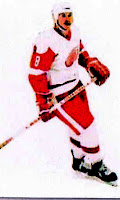
Can you remember a time when the Detroit Red Wings were a struggling franchise and a doormat of the NHL? Look up the sports news from the early 1980's and you'll find a team in desperate need of talent and identity. Lean times were upon the Red Wings as the team was shut out of the NHL post season six out of nine seasons, including a run from 1979 to 1983.

A year before in 1982, a new era was beginning to unfold in the Motor City hockey arena. Pizza magnate and avid sports fan Mike Illitch bought the team and installed up and coming assistant general manager Jimmy Devellano as the Red Wings new GM. It seemed as though Detroit's fortunes were slowly turning around. The Red Wings finally got back to the post season in back-to-back years in 1984 and 1985 being oustaded in the first round in both years, while adding one of the greatest players ever to wear the winged wheel on his chest - Steve Yzerman through the NHL draft in 1984.

By 1986, the Red Wings organization were ready to take the next step in the NHL winning heirarchy. Wanting to make a huge splash  Devellano waded into the undrafted, free agent waters, looking for those players that were not caught in the net of the NHL scouts trollers. Illitch gave Devellano the "all go" signal to allow the team to spend as much money as possible to land the biggest diamonds in the rough.

Those diamonds came in the form of a trio of  US college hockey players Ray Staszak, Tim Friday and Dale Krentz that were best forgotten by Red Wing fans. 
Ray Staszak

Staszak was coming off a wildly successful season as a junior at the University of Illinois-Chicago. Staszak was the CCHA player of the year and first all star after putting up 72 points in 38 games in 1985. Detroit needed a leg up on their Norris division foes and Staszak, standing at 6'0" 200 lbs, looked like he might be one of those talented gems that fell through the extensive NHL scouting ranks. And in the summer of 1985, Devellano was so convinced of Staszak's future pro potential, he signed the Pennsylvania native to highest free agent contract in league history at a whopping 1.3 million dollars over four years !!! This was an unheard of sum for such an unheard of player. Hockey experts and pundits throughout North America could believe what they have seen, heard and read.

Was Detroit actually breaking the bank for a untested college hockey player?  Yes, they had and now the pressure was on the 22-year-old to produce early and often.

But it was never to be for Staszak. Although he made the opening night roster for the Red Wings it would take four NHL games to supplant his future as a hockey oddity. Four games would all Staszak would ever see at the NHL level as he was sent down to the Detroit AHL farm team in Adirondack. A series of injuries to his shoulder and stomach permanently derail his once promising career and sour the Red Wings on this million-dollar flash-in-the-pan.


Tim Friday playing for RPI
Detroit continued it's 1985 college free agent foray, going after championship pedigreed defenseman Tim Friday. Friday was a star defenseman on the 1985 NCAA Div I champion Rensselaer Polytechnic Institute Engineers hockey team.


Friday with Detroit in 1986

At 6'10" 190 lbs, Friday wasn't a huge presence on the back end but he was known to be responsible in his own end of the ice and for finding the space for a quick pass up to the forwards. The Red Wings were trying to get younger on the back end and made a few trades to get the right combination speed, skill and size. Friday was supposed to fit that bill but after 23 games, posting no points and putting up a -9, the native of Calfornia was sent down to the AHL for the rest of the 1985-86 season after inccuring a shoulder injury. Friday regained his top form again in Adirondack, while helping the AHL team to the 1986 Calder Cup league championship. Friday never saw the bright lights of the Joe Louis Arena and the NHL again as he retired from hockey that summer, reportedly due to a worsening shoulder injury.

Dale Krentz was a solid forward
Krentz with Adirondack in 1988


Thursday, 20 October 2011

Drafted Into Obscurity < Dan Dorion >

The annals of National Hockey League are littered with incredibly talented also-rans and could've beens. A multitude of players who, if they had the right coaching and situations, might have gone on to dazzle a generation of fans and captivate their never-ending dreams of championships.

  
Dorion with Utica in 1987 
One such player had all the talent, magic hands and ice presence to succeed but none of the size to play such a physically demanding game - Dan Dorion. Standing at a diminutive 5'9" and weighing a small 180 lbs, Dorion was always given the unenvial task of proving himself time and time again because of his tiny stature. Even though he was a proven dominating sniper at every level of hockey he had played in, Dorion's size was always in question. And this was the case again in the summer of 1982 when the New York native was tapped by the newly-minted New Jersey Devils. Dorion's stock fell as a far any talented player's stock could fall as the Devils made him their last pick in the 12th round of the entry draft.

The NHL's braintrust have always held the belief that bigger is better. Year after year general managers around the league task their scouting staff to find the next great player who combines the important measures of size, speed and talent. And its always the same critirea in that same order. For players like Dan Dorion, who have incredible talent, the deck is consistently stacked against them. No matter how many goals they score (ironic, isn't that the object of the game??) little men who burn out the lamps with league-leading titlting tallies always seem to be looked upon with suspicion.
Western Michigan Mustangs

Maine in 1987
Dorion was lighting up the USHL for Austin, 96 points in 50 games, as an 18-year-old when the Devils came calling. The tiny scorer continued his development in the US college ranks at Western Michigan University. While with the Broncos, Dorion put up some prolific numbers running up an incredible 293 points over his four college years, placing him 8th overall for career NCAA men's hockey. In 1986, he was the runner up to the Hobey Baker award for best men's hockey player and was a finalist for the award two year's earlier in 1984.

 After such an amazing college career one would think NHL scouts would've been knocking down his door for a chance to draft such a talent. But it wasn't to be for Dorion as his size became his major stumbling block.

Utica in 1989
Dorion playing for his country in 1986
Dorion finally got his crack at the NHL in the spring of 1986, playing three games while adding his only points - one goal and one assist.
He was on his way to hockey obscurity after New Jersey left him to languish in the AHL for the next season in 1987, finally giving him another taste of NHL action - one last game in 1988.

Dorion as he could see the writing on the wall of his limited NHL career. He was traded to the Philadelphia Flyers AHL farm team in 1988 and Dorion was on his way to Europe permanently a year later in 1990.
As a footnote to his pro hockey career, Dorion had a four-year-run in the British Hockey League, starring for Nottingham and Humberside to close out his time on the ice.

Thursday, 18 August 2011

The Global Game

The Big Clothes Dresser

Legendary hockey players don't always come from the usual power nations of Canada, Russia, Sweden and Finland. There is always a once-a-generation player who stuns the world with his on-ice prowess and mind-bending skills from the outer-reaches international hockey. One such player starred on the professional hockey rinks of Germany and impressed the world at numerous international competitions during the 1970's and 1980's - Erich Kühnhackl.
Better known as the red-headed step child of the International hockey scene, German ice hockey has always been known as the also-rans in major ice hockey competitions. The Germans do a great job of competing but never truly test perennial contenders. But that was never the case when Kühnhackl was on the attack. Generally accepted as the greatest German hockey player ever, Kühnhackl was the perfect mix of height, speed and skill.

Standing at 6'5", Kühnhackl was a giant on the ice, towering over his competition all the while bringing legitimacy to German interanioanl hockey.

The West German star

Erich Kühnhackl

Friday, 8 July 2011

Drafted Into Obscurity < 1990 Calgary Flames >

Many organizations get snake-bitten by their decision-makers lack of foresight on player potential and skill brake down. Failed successive draft years can handcuff organizations for years and even decades. Therefore, drafting underage juniors into the highest level of hockey in the world, the NHL, can be considered an advanced skill and even an art. To find those players who are diamonds in the rough no matter where they play their hockey in the world and develop them wisely is what sets great teams apart from the wanna-be’s.  Draft disasters separate the quality from obscurity.
The Calgary Flames team found themselves with this same problem, coming off their one and only Stanley Cup championship in the spring of 1989. The Flames veteran-laden lineup was changing over quickly with ownership creating an unsettling atmosphere for coaches and players alike. By the end of the 1990 season gone were the heady days of Flames legends and key contributors Lanny McDonald, Joe Mullen and Hakan Loob. Coach Terry Crisp and GM Cliff Fletcher were also on their way out as the Flames franchise made major wholesale changes.
Nicolas Perreault
Of course the Flames management looked to the draft to fill some of the gaping holes left by those legendary players. Rebuilding began in earnest at the 1990 draft as the Flames shored up their goaltending by taking the consensus number one ranked overall major junior net minder that year, Trevor Kidd. What transpired next for Calgary in the second round of the 1990 draft continues to baffle the minds of hockey experts and pundits alike. For their first of three picks in the second round, Flames management engineered a deal with the Pittsburgh Penguins to trade one of their leaders and future HOF sniper, Joe Mullen, for an unknown, off-the-board, Ontario tier two defenseman and true prospect by the name of Nicolas Perreault at #26.
Mullen went on to be an instrumental player in Pittsburgh’s back-to-back Stanley Cups in 1991 and 1992 and eventually became the second highest scoring American player in NHL history while being inducted into the HOF in 2000.Perreault was coming off an extremely successful season as the Central Ontario Junior "A" Hockey League's top defenseman and rookie-of-the-year, leading his Hawkesbury Hawks to become regular season and playoff champions, while signing a letter-of-intent with the CCHA’s Michigan State Spartans.
A true long-shot prospect, Perreault would never patrol an NHL blue line and became lost in the annals of hockey lore forever. After four unspectacular years in college at Michigan State, Perreault only played a paltry 84 minor league professional hockey games over two years with Saint John of the AHL and Toledo of the ECHL and in less than 10 years he was out of hockey for good.
Viitakoski with the
 1993 Calgary Flames
But this disastrous draft tale for the Calgary Flames does not end here.  Continuing on further into the second round of the 1990 draft, the Flames looked off-continent to Finland for their second pick at #32 as they selected huge left winger Vesa Viitakoski. The 6’3” 209 lb Viitakoski was a promising young scorer who put some flashy numbers in the Finnish junior league and World juniors from 1988 to 1990 -and 1991. Viitakoski appeared to have the physical presence NHL GM’s were always yearning for and the big Finnish winger decided to continue his seasoning back home in Finland until the end of the 1993 season.

Viitakoski with the
1994 Saint John Flames
The Flames roster was a revolving -door on the bottom two lines which gave Viitakoski a legitimate shot at making the Flames straight out of camp in fall of 1993. Left wing was pretty bare with only Gary Roberts cemented in at the first line spot. Viitakoski debuted in the NHL, scoring three points in eight games, while spending most of the 1993-1994 campaign with the Flames AHL farm team in Saint John. While with Saint John, Viitakoski was a point a game player, putting up 28 goals and 67 points in 67 games to finish third in team scoring.
It looked like 1994-1995 was going to be Viitakoski’s year to really crack the Calgary line-up but only saw action in only 10 NHL games, scoring 3 points and not impressing Flames management enough for more call-up time. Viitakoski’s production slipped a little in Saint John as he finished with 43 points but a lack-luster performance and little improvement had Flames management souring on him.
Viitakoski in 2010 with Ilves
By 1996, Viitatoski saw the last of his NHL action ever and was promptly traded to the Colorado Avalanche for Paxton Schulte. Now back in the AHL with Cornwall, Viitakoski never got a shot in Colorado and was back in Finland after a one year stint in Sweden by 1998. He continued playing top level pro hockey in his homeland of Finland with a brief second stop in Sweden up until recently in 2010, totaling a 20 year career of top level professional hockey.  


For their third pick in the second round of the 1990 NHL draft, the Calgary Flames went off the board again, mystifing scouts and experts, selecting Cornell d-man Etienne Belzile at #41. In his four years of college Belzile was an outstanding stay-at-home, shut-down defenceman for the Big Red, averaging four points a season. The Flames seemed to be adding depth to their backline with another hard-rock hitter but Belzile never played an NHL game. Fans and critics must have been questioning why the Flames scouting staff were so high on this player. At the time, Belzile was concentrating on a medical degree and preparing for a potential future in an area that had nothing to do with hockey - neurosurgery!!! But once again Calgary scouts and management had other ideas and went with a very risky selection. By the time Belize graduated from Cornell three years later, the defenceman was out of hockey and on his way to becoming a doctor of medicine, fading into hockey obscurity forever.