The Big Clothes Dresser
Legendary hockey players don't always come from the usual power nations of Canada, Russia, Sweden and Finland. There is always a once-a-generation player who stuns the world with his on-ice prowess and mind-bending skills from the outer-reaches international hockey. One such player starred on the professional hockey rinks of Germany and impressed the world at numerous international competitions during the 1970's and 1980's - Erich Kühnhackl.
Better known as the red-headed step child of the International hockey scene, German ice hockey has always been known as the also-rans in major ice hockey competitions. The Germans do a great job of competing but never truly test perennial contenders. But that was never the case when Kühnhackl was on the attack. Generally accepted as the greatest German hockey player ever, Kühnhackl was the perfect mix of height, speed and skill.
Standing at 6'5", Kühnhackl was a giant on the ice, towering over his competition all the while bringing legitimacy to German interanioanl hockey.
The West German star
Erich Kühnhackl
Thursday, 18 August 2011
Friday, 8 July 2011
Drafted Into Obscurity < 1990 Calgary Flames >
Many organizations get snake-bitten by their decision-makers lack of foresight on player potential and skill brake down. Failed successive draft years can handcuff organizations for years and even decades. Therefore, drafting underage juniors into the highest level of hockey in the world, the NHL, can be considered an advanced skill and even an art. To find those players who are diamonds in the rough no matter where they play their hockey in the world and develop them wisely is what sets great teams apart from the wanna-be’s. Draft disasters separate the quality from obscurity.
The Calgary Flames team found themselves with this same problem, coming off their one and only Stanley Cup championship in the spring of 1989. The Flames veteran-laden lineup was changing over quickly with ownership creating an unsettling atmosphere for coaches and players alike. By the end of the 1990 season gone were the heady days of Flames legends and key contributors Lanny McDonald, Joe Mullen and Hakan Loob. Coach Terry Crisp and GM Cliff Fletcher were also on their way out as the Flames franchise made major wholesale changes.
![]() |
| Nicolas Perreault |
Of course the Flames management looked to the draft to fill some of the gaping holes left by those legendary players. Rebuilding began in earnest at the 1990 draft as the Flames shored up their goaltending by taking the consensus number one ranked overall major junior net minder that year, Trevor Kidd. What transpired next for Calgary in the second round of the 1990 draft continues to baffle the minds of hockey experts and pundits alike. For their first of three picks in the second round, Flames management engineered a deal with the Pittsburgh Penguins to trade one of their leaders and future HOF sniper, Joe Mullen, for an unknown, off-the-board, Ontario tier two defenseman and true prospect by the name of Nicolas Perreault at #26.
Mullen went on to be an instrumental player in Pittsburgh’s back-to-back Stanley Cups in 1991 and 1992 and eventually became the second highest scoring American player in NHL history while being inducted into the HOF in 2000.Perreault was coming off an extremely successful season as the Central Ontario Junior "A" Hockey League's top defenseman and rookie-of-the-year, leading his Hawkesbury Hawks to become regular season and playoff champions, while signing a letter-of-intent with the CCHA’s Michigan State Spartans.
A true long-shot prospect, Perreault would never patrol an NHL blue line and became lost in the annals of hockey lore forever. After four unspectacular years in college at Michigan State, Perreault only played a paltry 84 minor league professional hockey games over two years with Saint John of the AHL and Toledo of the ECHL and in less than 10 years he was out of hockey for good.
![]() |
| Viitakoski with the 1993 Calgary Flames |
![]() |
Viitakoski with the
1994 Saint John Flames
|
The Flames roster was a revolving -door on the bottom two lines which gave Viitakoski a legitimate shot at making the Flames straight out of camp in fall of 1993. Left wing was pretty bare with only Gary Roberts cemented in at the first line spot. Viitakoski debuted in the NHL, scoring three points in eight games, while spending most of the 1993-1994 campaign with the Flames AHL farm team in Saint John. While with Saint John, Viitakoski was a point a game player, putting up 28 goals and 67 points in 67 games to finish third in team scoring.
It looked like 1994-1995 was going to be Viitakoski’s year to really crack the Calgary line-up but only saw action in only 10 NHL games, scoring 3 points and not impressing Flames management enough for more call-up time. Viitakoski’s production slipped a little in Saint John as he finished with 43 points but a lack-luster performance and little improvement had Flames management souring on him.
![]() |
| Viitakoski in 2010 with Ilves |
For their third pick in the second round of the 1990 NHL draft, the Calgary Flames went off the board again, mystifing scouts and experts, selecting Cornell d-man Etienne Belzile at #41. In his four years of college Belzile was an outstanding stay-at-home, shut-down defenceman for the Big Red, averaging four points a season. The Flames seemed to be adding depth to their backline with another hard-rock hitter but Belzile never played an NHL game. Fans and critics must have been questioning why the Flames scouting staff were so high on this player. At the time, Belzile was concentrating on a medical degree and preparing for a potential future in an area that had nothing to do with hockey - neurosurgery!!! But once again Calgary scouts and management had other ideas and went with a very risky selection. By the time Belize graduated from Cornell three years later, the defenceman was out of hockey and on his way to becoming a doctor of medicine, fading into hockey obscurity forever.
Saturday, 2 July 2011
Drafted Into Obscurity < Scott Scissons >
![]() |
| 1989 Saskatoon Blades |
Scott Scissons was living the Canadian dream.
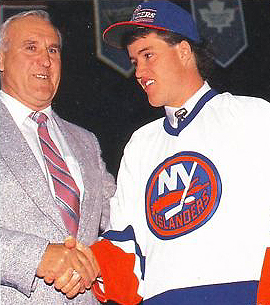
After two stellar seasons with his hometown Saskatoon Blades, he was picked sixth overall in the 1990 NHL entry draft by the New York Islanders. Jaromir Jagr, a future Hart Trophy winner as the most valuable player in the NHL, was selected one spot earlier.
After five injury-plagued seasons as a journeyman pro, and three games in the NHL, he retired in 1995. "Without question it's disappointing," says Scissons.
"It was as good a chance as anybody at that age. I just spent more time in the hospital than I did on the ice." Scissons's medical record has no competitors.
Scissons, 34, is more than comfortable with his turn of events. "I wouldn't change much. There's certain things you can control and you can't control the injuries.
Drafted Into Obscurity < Rocky Trottier >
Not all hockey players can survive the rigors of the professional game on talent alone. A few players get more attention from big league scouts because they have the "right" last name. Having those familiar letters on the back of your jersey can almost guarantee you a shot at leap frogging over more capable teammates and competition.
In this addition to the long list of pro hockey players who eventually got Drafted Into Obscurity, we take a look at a player who toiled in shadow a vastly talented big brother and NHL legend, Rocky Trottier.
![]() |
| Rocky Trottier with Medicine Hat Tigers |
Maybe Rocky Trottier was destined to become an NHL'er. It appeared that he certainly was blessed with fantastic lineage which should've paid off handsomely for the Saskatoon native. But cursed was more like the reality for Western Hockey League junior.
Being the little brother of an already established NHL star probably weighed a little heavy on the average major junior. Over his four years in the WHL, Trottier posted a not too spectacular over a point-a-game pace. In his final year, Trottier began to show some flashes of what might become after scoring 84 points in 65 games,adding a solid 15 more in Memorial Cup action. That late display of talent might have given him a small chance at a pro hockey career, if it wasn't for that promising last name and what it meant.
In 1982, times were changing in the NHL, the eight-year run of the Colorado Rockies had come to an end with new owners moving the franchise to the largest sports market in North America. The New Jersey Devils were born out of the swamps of eastern metropolitan New York. The new owners knew what they were up against in the powerhouse, storied Ranger fan-base and new dynasty rivals Islanders - major competition. They needed a quick foothold into the market and what better way to make a splash by drafting the little brother of NHL mega star Bryan Trottier. Tempted by the family lineage promise, the Devils selected Rocky Trottier with their first pick, eighth overall in the first round of the 1982 NHL draft.
He debuted in the NHL after a successful run in the Memorial Cup playoffs in 1984, scoring 2 points in 5 games. By September, Trottier had made the Devils and was ready to begin another NHL brother rivalry. After splitting the 1984-85 season between the farmclub and parent club, Trottier worked hard to stick as an NHL regular. By 1986, he never got another shot at the big leagues, playing a total of 35 NHL games over two seasons. He continued to langish in the AHL with Maine, not impressing Devils brass and by the fall of 1987, Trottier was on his way to hockey obscurity and out of the North American pro scene.
Trottier would head to Europe to play two more seasons of unspectacular hockey in Div II clubs in Sweden and Germany. He played one last season, making an unsuccessful return to North America in 1989-90, suiting up for the AHL's Hersey Bears.
Trottier was the perfect example of potential on name but not on pure talent. Luckily for New Jersey, 1982 turned out to be one of the weakest NHL drafts for underage juniors and Rocky Trottier's legacy became more of a footnote and sports game show stump-er than a franchise fiasco.
In 1982, times were changing in the NHL, the eight-year run of the Colorado Rockies had come to an end with new owners moving the franchise to the largest sports market in North America. The New Jersey Devils were born out of the swamps of eastern metropolitan New York. The new owners knew what they were up against in the powerhouse, storied Ranger fan-base and new dynasty rivals Islanders - major competition. They needed a quick foothold into the market and what better way to make a splash by drafting the little brother of NHL mega star Bryan Trottier. Tempted by the family lineage promise, the Devils selected Rocky Trottier with their first pick, eighth overall in the first round of the 1982 NHL draft.
![]() |
| 1984 with the New Jersey Devils |
Trottier would head to Europe to play two more seasons of unspectacular hockey in Div II clubs in Sweden and Germany. He played one last season, making an unsuccessful return to North America in 1989-90, suiting up for the AHL's Hersey Bears.
Trottier was the perfect example of potential on name but not on pure talent. Luckily for New Jersey, 1982 turned out to be one of the weakest NHL drafts for underage juniors and Rocky Trottier's legacy became more of a footnote and sports game show stump-er than a franchise fiasco.
Thursday, 30 June 2011
Drafted Into Obscurity < Wayne Groulx >
Promising careers, bright futures and undeniable talent. Are they guarantees for success? You certainly can't have one without the other if you want longevity playing at the highest level of hockey leagues on the planet. There is no room for compromise, but there is uncontrollable circumstance. No matter what kind of player you are, you have to bring it every night and keep proving it over and over. Many of the players written about in these series of blogs are victims of the aftermentioned circumstance.
One of the greatest major junior hockey players ever to don a jersey is another skater with great expectations who eventually succumbed to being Drafted Into Obscurity - Wayne Groulx.
Although his physical stature might have been questioned, only standing 5'9" 175 lbs., no one could ever wonder about his ability to score goals. Groulx was a scoring machine. Over his four wildly successful years in the Ontario Hockey League, Groulx was able to accumulated 187 goals, including three straight seasons scoring over 130 points plus. Considered by many as the second-best Sault Ste. Marie Greyhound player ever in the 49-year history of the franchise, (the first being none other than the Great Gretzky) Groulx currently sits third overall in OHL career points with 477.
Two years later in 1985, after Groulx was named the OHL MVP while leading his squad to the Memorial Cup semi's in fine fashion, he made his debut in the NHL. Most critics say Groulx got caught in a numbers game in Quebec. There were too many established players on that Stanley Cup contending team and it was virtually impossible for him to crack such a veteran laden lineup. Whatever the reason, Groulx would never been seen again playing at the highest level hockey again. Groulx continued to play in the Quebec farm system for the next three years, splitting time between the IHL and AHL while spending brief time on the Canadian National squad. From top junior performer to out of North American hockey in less than three years, Groulx was on a fast track to hockey obscurity.
By 1988, Groulx went to Europe to continue with his pro hockey career with a quick stop with a team in Division II in Finland. He eventually found a home in the Austrian league and played out his career over the next six years.
One interesting side note to his career, Groulx represented Austria at the 1992 B Pool World Championships. Groulx' 14 points in seven games led the Austrians to the tournament title and promotion to A Pool for the next year. In 1992-93, he helped Austria finish ninth out of twelve teams at the World tourney. He retired in 1994 after playing one last year in Austria.
One of the greatest major junior hockey players ever to don a jersey is another skater with great expectations who eventually succumbed to being Drafted Into Obscurity - Wayne Groulx.
![]() |
| Groulx with the OHL's Greyhounds |
Although his physical stature might have been questioned, only standing 5'9" 175 lbs., no one could ever wonder about his ability to score goals. Groulx was a scoring machine. Over his four wildly successful years in the Ontario Hockey League, Groulx was able to accumulated 187 goals, including three straight seasons scoring over 130 points plus. Considered by many as the second-best Sault Ste. Marie Greyhound player ever in the 49-year history of the franchise, (the first being none other than the Great Gretzky) Groulx currently sits third overall in OHL career points with 477.
Being a superstar in major junior doesn't always punch your card to be a regular in the National Hockey League. In Groulx case, the Quebec Nordiques were such a deep and talented team in the mid-1980's that the franchise waited until midway through the ninth round, #172, of the 1983 NHL draft to select him.
![]() |
| 1985-86 Muskegon Lumberjacks |
Two years later in 1985, after Groulx was named the OHL MVP while leading his squad to the Memorial Cup semi's in fine fashion, he made his debut in the NHL. Most critics say Groulx got caught in a numbers game in Quebec. There were too many established players on that Stanley Cup contending team and it was virtually impossible for him to crack such a veteran laden lineup. Whatever the reason, Groulx would never been seen again playing at the highest level hockey again. Groulx continued to play in the Quebec farm system for the next three years, splitting time between the IHL and AHL while spending brief time on the Canadian National squad. From top junior performer to out of North American hockey in less than three years, Groulx was on a fast track to hockey obscurity.
By 1988, Groulx went to Europe to continue with his pro hockey career with a quick stop with a team in Division II in Finland. He eventually found a home in the Austrian league and played out his career over the next six years.
![]() |
| 1994 World Championships - Austria |
Thursday, 16 June 2011
Drafted Into Obscurity < Art Rutland >
Thumb through the sportspages, flick by the never-ending highlights and you're bound to miss the not-so famous players exposed in this hockey oddity blog. Young men who had dreams of skating under the bright lights of big city National Hockey League arenas. Promising careers that never panned out. Can't miss prospects who, for some reason or another, couldn't put it all together and ended up in pro hockey obscurity...
In this first installment of Drafted Into Obscurity we take a look at a sure-fire, can't miss Vancouver Canuck prospect Arthur Rutland.
Moving into the 1980's the Canucks were below-average franchise, struggling to find it's identity. The team suffered through some very lean, sub-500 years in the late 70's and ownership decided start on a major renovation by changing the entire look and feel from the cool green and blue hockey stick motif to a radical black, orange and yellow Hallowe'en "inspired" redesign.
The Canucks also needed an overhaul in the scoring department. The team was in desperate need of top-line help and Rutland was tagged by Vancouver in the fourth round of the 1979 NHL draft, 68th overall.
This would be a draft selection the Canucks orgnization would lament for years to come. Rutland was drafted one spot ahead of future Hall Of Famer and local Burnaby, BC boy Glenn Anderson. Anderson enshrined his name on five Stanley Cups (four with Edmonton, one with New York) and also represented Canada at the 1980 Olympics. The University of Denver standout totaled 1099 points in 1129 NHL games played, including almost joining the elite 500 NHL goal club by falling short by two at 498 - Anderson became a NHL legend.
Rutland was just coming off a stellar four-year Ontario Hockey League (formely known as the OMJHL) career from 1976-1980. In 1978-79, while playing for the Sault Ste. Marie Greyhounds, Art caught the attention of NHL scouts. Rutland put up an impressive 139 points, finishing third overall in league scoring. Overall, Rutland contributed 365 points over his four seasons in the OHL despite playing on dismal teams that placed in the depths of the league.But what Rutland might be most well-known for was sharing the bench with the possibly the greatest player the game of hockey has ever produced. In his second season with the Greyhounds, Rutland was teammates with incomprable Wayne Gretzky
What could have been for Art Rutland? By 1982, the Vancouver Canucks made an improbable run to the Stanley Cup finals against the dynasty, power-house New York Islanders. Unfortunately, Rutland was never part of that memorable season. Rutland had made the Canucks opening roster out of camp in October of 1981 but never was able to stick and would never play at the NHL level again.
![]() |
| Art Rutland on 1981-82 Vancouver Canucks |
He played just three seasons from 1980-1983 on the North American pro hockey circuit for the Canucks farm clubs. Rutland did show some promise while suiting up for the Central Hockey League’s Dallas Black Hawks in 1980-81. Rutland was a true playmaker leading the league by posting 65 assists. Surprisingly after playing so well, Rutland never got the call-up he was hoping for.
He went on to play his final season of pro hockey in North America in 1982-83 with the Fredericton Express of the American Hockey League.
![]() |
Subscribe to:
Posts (Atom)